


Network at a glance
70 organizations across 9 categories
The network includes 70 organizations spanning industry, higher education, K-12, community, workforce development, government, healthcare, EPIIC program infrastructure, and the NSF EPIIC cohort. 32 nodes are confirmed through direct program evidence, 18 are inferred from regional knowledge and meeting summary analysis, and 20 are placeholder nodes awaiting verification.
80 connections with EPIIC attribution
Eighty connections link partners across the network, each tagged with the EPIIC activity or mechanism that created or strengthened the relationship, from faculty externships and micro-credential co-development to symposium co-participation and congressional visits.
~3.3% network density
With 80 connections out of 2,415 possible (70 x 69 / 2), the network has a density of approximately 0.033. This reflects the typical structure of a large partnership ecosystem where most organizations connect through hub institutions rather than directly to each other.
4 EPIIC spheres with cross-sphere bridging
Nodes span all four EPIIC evaluation spheres: Industry & Economic Development (Fortune 500 corridor plus regional biotech), Higher Education Leadership (multi-state university network), Faculty (CURE workshops, externships, micro-credentials), and Community (K-12, cultural institutions, civic organizations). Key partners like BCSI bridge multiple spheres.
Hub organizations
Four organizations emerge as structural hubs based on their connection count and bridging role across the network.
NWACC EPIIC Program
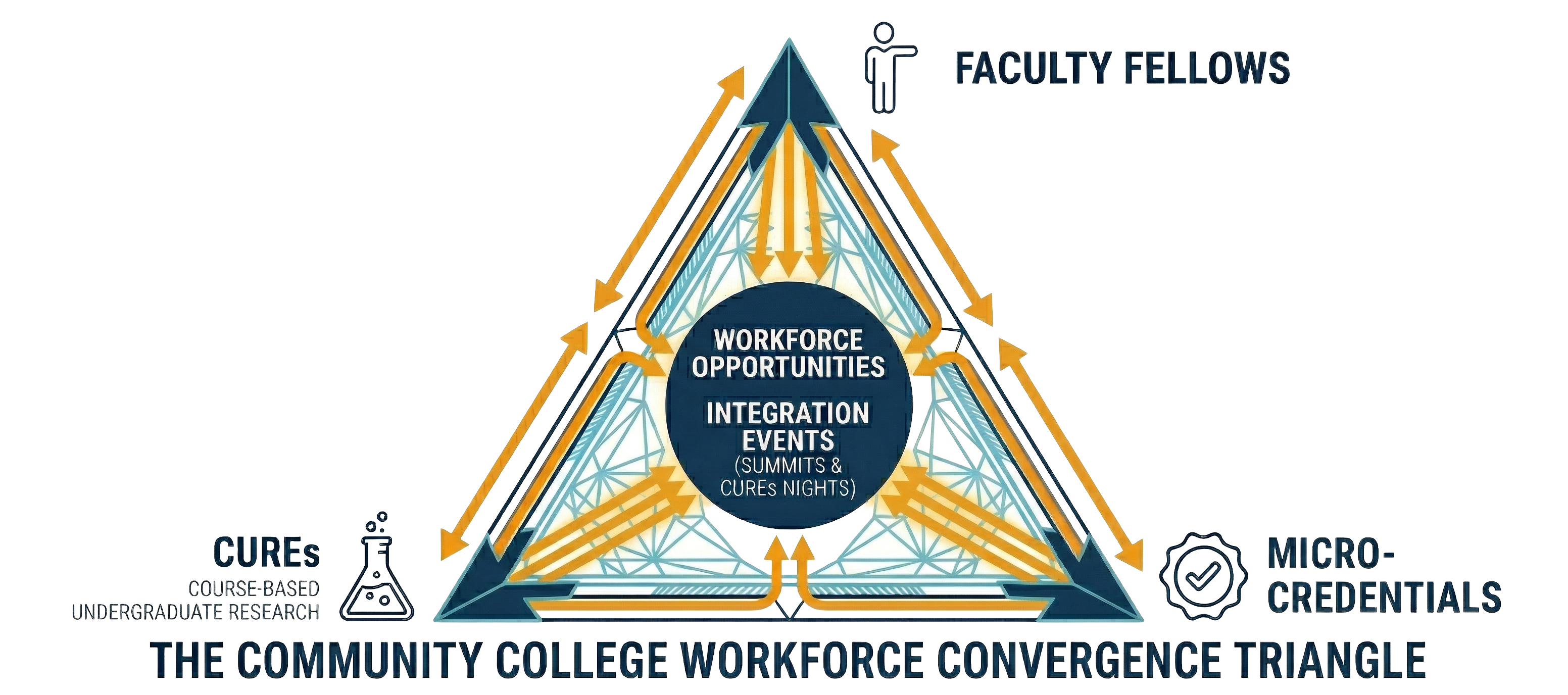
The NWACC EPIIC Program node represents the internal network infrastructure: the Community College Workforce Convergence Triangle (Micro-credential Pipeline, CUREs Coordination, Faculty Fellows) plus supporting institutional units (Grants Office, VP/Administration, Leadership & Govt Relations, Marketing, IRB, Internship Coordination). When expanded, these units connect to partners across every category, from NSF and FIPSE through the Grants Office, to industry partners through Faculty Fellows and the Micro-credential Pipeline.
NWACC Symposium / Events
NWACC's Biotech Symposium (a half-day Y1 event, with hopes to expand to a two-day format in future years) connects industry partners, regional universities, community organizations, and vendors. The Chamber of Commerce, Crystal Bridges, VWR Scientific, and ULM all connect through the symposium. Canisius cited this conference model as influential in their own EPIIC work.
BCSI (Bioscience Core Skills Institute)
CEO Angela Cassani's organization bridges industry, credentials, and workforce development. BCSI co-develops industry micro-credentials with NWACC, operates a talent marketplace integrated with Smart Resume and Arkansas Launch, and organized multi-state biotech meetings connecting BioArkansas and BioOklahoma. Named as NSF-Catalyzed Partner on TTP-T, TTP-E, and FIPSE proposals.
University of Arkansas
Major partner across multiple dimensions: Beth's externship in molecular ecology lab, multiple departments at Symposium, VR bioreactor NSF grant collaboration, Upward Bound pipeline to NWACC, and faculty who own startups. Connected to MASS Center, ARA, and state higher-ed coordination. Named as TTP-T partner.
Thematic clusters
The network organizes into five recognizable clusters that reflect the NW Arkansas regional landscape and NWACC's strategic positioning.
Fortune 500 corridor
Walmart/Walton Family, Tyson Foods, and J.B. Hunt Transport, three Fortune 500 companies with headquarters in the Bentonville-Springdale-Lowell corridor. Connected through the NW Arkansas Council and Wheeler Corporation (medical manufacturing CEO expressed strong interest in NW Arkansas expansion). The Walton Foundation funds UofA's IR3 building and is referenced in the FIPSE critique. This concentrated corporate presence creates distinctive partnership potential.
EPIIC cohort network
The Cohort Hub links NWACC to Canisius University, Albion College, Roanoke College, and NSF/EPIIC. These are confirmed, documented relationships. The cohort network provides cross-institutional learning, shared IRB frameworks, and collective problem-solving. Roanoke co-applied for TTP-E with NWACC.
4-state bio-corridor
BioArkansas, BioOklahoma, BioKansas, and BioMissouri form a multi-state consortium with BIOTC (Oklahoma biomanufacturing training center). Angela Cassani (BCSI) initiated regional meetings in Oklahoma City. Luna Costis at BioArkansas is stationed at A-State. Kansas institutions confirmed as 2026 Summit speakers. This cluster represents an emerging regional biotech workforce development network, and NWACC is actively shaping its direction.
Higher ed research pipeline
University of Arkansas, Arkansas State, UAMS, MASS Center, MVP Center, CeBEC/ASCB, Embry, ULM, and Rose State College form an extensive higher-ed research network. This cluster includes 2+2 articulation agreements (Dean-to-Dean with A-State), cross-institutional CUREs (Embry funding bioinformatics), tissue sharing (UAMS mice livers/hearts), and NSF I/UCRC participation. CeBEC workshop led by NWACC reached 50 faculty; 9 students presented at ASCB Philadelphia.
Community and K-12
Crystal Bridges Museum (Walmart-founded cultural anchor with The Momentary), Bentonville Chamber of Commerce, Local Recycling Center (organic biocomposting partnership), and Upward Bound/TRIO (1/3 to 1/2 of students attend NWACC first). The Recycling Center represents an organic, community-embedded partnership with CURE and internship potential.
Regional biotech industry cluster
A group of invited and potential partners represents NWACC's expanding industry reach: PelFreez (biological products), NowDX (diagnostics), Namida Lab, SFC Fluidics (microfluidics), Nanomatronix (nanotechnology), Biotech Pharmacal, Lineus Medical (medical devices), Berries Unlimited (agriculture/biotech), Zystein, OurPharma, George's, Simmons Foods, and Cargill. The healthcare sector adds NWA Pathology, Highlands Oncology, Mercy Hospital, and Washington Regional Medical. These potential partners signal the breadth of the regional biotech ecosystem available to NWACC.
Data collection priorities
The upcoming NWACC symposium presents a natural opportunity to verify connections, identify missing partners, and collect co-participation data. Event observation, informal conversations, and a partnership mapping activity could convert many inferred connections to confirmed status.
Highest priority gaps
Healthcare sector depth. Four healthcare nodes (NWA Pathology, Highlands Oncology, Mercy, Washington Regional) are all placeholders. Allied Health interest in EPIIC fellowship suggests deeper connections exist but are not yet documented.
Community organization specifics. The community sphere has strong confirmed anchors (Crystal Bridges, Recycling Center, Chamber) but lacks the civic and cultural organizations serving NWACC's diverse student body, particularly the Marshallese and Hispanic/Latino communities.
Invited partner activation. Many industry nodes (PelFreez, NowDX, Namida, etc.) are listed as invited or potential. Tracking which attend the 2026 Summit and which develop active relationships will clarify this cluster.
Internal department connection mapping. The NWACC EPIIC Program internal network captures multiple units, but edge routing to specific departments (vs. the institution as a whole) needs verification from Dr. Gary Bates and Dr. LaShall Bates.
Degree centrality rankings (top 20)
| Organization | Category | Confidence | Connections |
|---|